Every millisecond of every day, a remarkable sequence of events occurs in the brain: billions of brain cells called neurons transmit signals to each other. And they do it at trillions of junctions called synapses. It is an extremely fast and efficient process — one central to everything the brain does, including learning, memorizing, planning, reasoning, and enabling movement.
When even one part of the process breaks down, the results can be devastating. Many brain disorders and nervous system diseases, including autism, schizophrenia, Alzheimer’s disease, epilepsy, and even botulinum poisoning, have been linked to problems at the synapse.
Thanks to advances in molecular cell biology, neuroscientists have pieced together many of the step-by-step details going on at synapses. They discovered different molecules play special roles to make sure neurotransmitters — the chemicals that carry the messages from one neuron to another — are released. This exciting research is leading to:
A deeper understanding of the cellular processes involved in neural communication.
Awareness of breakdowns in neurotransmitter release that may contribute to brain diseases and disorders
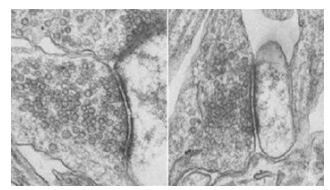
How the neuron releases neurotransmitters has been the focus of considerable research. Scientists discovered neurotransmitters are stored in small, bubble-like compartments called vesicles. Each vesicle tends to hold a single kind of neurotransmitter — say, dopamine, which is associated with memory and other cognitive skills, or serotonin, which helps regulate mood.
The vesicles travel like tiny ferryboats to the end of the neuron, where they dock, waiting to be released. When it is time for the neuron to release neurotransmitters, the vesicles fuse with the membrane of the neuron and dump their contents into the synapse gap. The delicate fusion process — described as the merging of two soap bubbles into one — is highly complex and involves the work of many different and specialized molecules within the neuron. After neurotransmitter release, the neuron recycles the empty vesicles, refilling and reusing them several more times before they need to be replaced.
If any part of this process goes awry — if a molecule fails to do its job properly or if the vesicles release their neurotransmitters at the wrong speed — serious problems may develop. Neurotransmitter release problems may also contribute to certain psychiatric disorders. By identifying such breakdowns in neurotransmitter release, scientists hope to develop treatments that may one day reverse the symptoms of several devastating brain disorders. Ongoing research on neurotransmitter release continues to unlock the mysteries of brain health and disease.
(Adapted from: http://www.brainfacts.org/)
―[…] Ongoing research on neurotransmitter release continues to unlock the mysteries of brain health and disease.‖ ―Ongoing‖ would best replaced by: