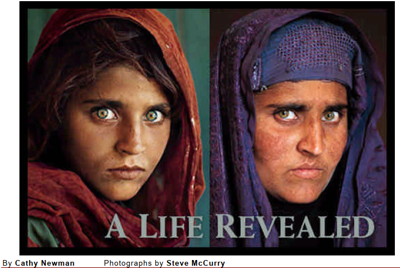
Her eyes have captivated the world since she appeared non our cover in 1985. Now we can tell her story
Get a taste of what awaits you in print from this compelling excerpt.
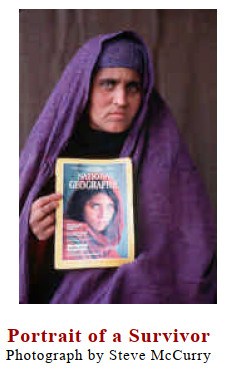
Names have power, so let us speak of hers. Her name is Sharbat Gula, and she is Pashtun, that most warlike of Afghan tribes. It is said of the Pashtun that they are only at peace when they are at war, and her eyes—then and now—burn with ferocity. She is 28, perhaps 29, or even 30. No one, not even she, knows for sure. Stories shift like sand in a place where no records exist. Time and hardship have erased her youth. Her skin looks like leather. The geometry of her jaw has softened. The eyes still glare; that has not softened.
http://mesa.nationalgeographic.com/ngm/afghangirl/index.html
The young Afghan refugee who stared from the cover of National Geographic in June 1985 was an enigma for 17 years. What was her name? Had she survived? This past January photographer Steve McCurry joined a crew from National Geographic Television & Film to methodically search for her. They showed her photograph around the refugee camp in Pakistan where McCurry had encountered her as a schoolgirl in December 1984. Finally, after some false leads, a man who had also lived in the camp as a child recognized her. Yes, she was alive. She had left the camp many years before and was living in the mountainous Tora Bora region of Afghanistan. He said he could find her, and three days later he and a friend brought her back to the camp. There, the remarkable story of this woman, Sharbat Gula, began to be told.
http://mesa.nationalgeographic.com/ngm/afghangirl/zoom1.html
O que permanece inalterado em Sharbat Gula é a