SOMATÓRIO
TEXT 1
CHARLIE CHAPLIN – A COMIC GENIUS
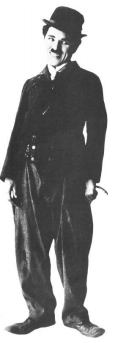
One of the most important and influential figures in the history of motion pictures, Charlie Chaplin was perhaps the greatest comedian to have ever lived. He made his reputation in 1914 when, in his second film, Kid Auto Races at Venice, he introduced the world to the helpless “little tramp.” With his smudge moustache, baggy trousers and bowler hat, and twirling his cane, the tramp soon had cinema audiences entranced. It was a fantastic creation, stirring up emotions, both happy and sad, and Chaplin played that classic role in more than 70 films during his career, earning him both a fortune and international fame.
Chaplin’s beginnings never promised such success. Though born into a wealthy London family, the good times quickly disappeared. His father deserted when Charlie was an infant (and later died of alcoholism) and his mother, a successful music hall star, had a nervous breakdown and was sent to an asylum. Charlie thus found himself in an orphanage. It was the theatre that gave Chaplin his first release from the pressures of troubled life. He made his debut in 1894, appearing on stage with his mother. Later he became part of Fred Karno’s music hall troupe and went with them on their American tour of 1912. It was while the company was in the United States that the young Chaplin was spotted by the film director Mack Sennett and signed to Keystone Films at 150 dollars a week. Over the next few months Chaplin made dozens of films for Keystone many of which featured his newly created “little tramp” character.
From: Speak Up. Agosto 1999 – no 147 (adapted).
Read the summaries below. Which one (s) contains (contain) the same information found in the text?
01. According to the text, Chaplin stands as one of the greatest comedians ever, being also a relevant and powerful person in the history of the movie industry. His success is due to a character he created, known as the “little tramp”. First introduced to the world in Kid Auto Races at Venice, the “little tramp” appeared in all Chaplin’s movies and earned money and fame. Chaplin was meant to be successful since the beginning of his career. Born into a rich family, Chaplin was sent to an orphanage when his father and mother died. In 1912 he went on a tour with Karno’s music hall troupe, but his first performance on stage was in 1894. When touring with Karno’s group, Chaplin was invited to film Keystone for 150 dollars a week.
02. In the text it is said that Chaplin gained one of the highest positions as a comedian in the cinema world. The text also describes the character that brought Chaplin fame and fortune and shows when his career blossomed. Besides that, we are told about who was responsible for his recognition and the number of times Chaplin performed his “little tramp” character in the films he took part in during those years. On the other hand, we learn how difficult Chaplin’s life was when he was very young.
04. The text refers to Charlie Chaplin as one of the greatest comic actors in the whole history of motion pictures. It also tells how Chaplin gained success through the creation of his famous character – the “little tramp” – and presents a brief description of him. Besides that, the reader is informed about the hard times Chaplin had to overcome still as a child, since his father left and his mother became seriously ill. The text also mentions when Chaplin’s talent was recognized and who took part in this process. Finally, the last lines of the text show us that Chaplin played the role of his new character in many films he made at that time.
08. Chaplin, the greatest comedian in the history of motion pictures, started his career in 1914, with Kid Auto Races at Venice. After having lived in an orphanage, he made his first public appearance in 1894, with his mother. Chaplin was invited to work for Keystone Films by Mack Sennet, who brought him fame and fortune.