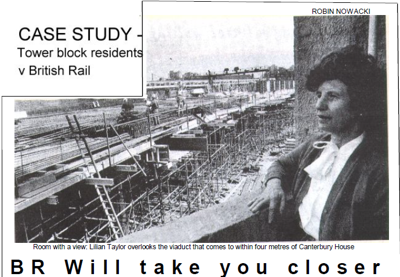
THERE’S close and there’s very close. This is very close.
When the Channel tunnel opens in two years’ time, up to 1,600 passengers an hour leaving Waterloo International for the Continent will be able to share uninterrupted views of June Beckett’s kitchen and bedroom.
She, in turn, will have the pleasure of knowing that from her second-floor balcony she is as near as it is physically possible to be to one of the biggest civil engineering feats of the decade. Twelve feet, in fact.
But for her, and the other residents of Canterbury House, just south of the Thames, delight at the prospect of rubbing shoulders with greatness is offset by the sight and sounds of a viaduct-widening scheme that has cast everything below second-floor level into permanent shade, and replaced one of the few areas of green space in a congested part of the capital with a concrete monolith planted literally on their doorstep.
“They knocked down our pub to make way for it,” says Lilian Taylor, who has lived at No 26 with her husband and teenage son for 14 years. “A real old London pub.
Trevor Barnes talks to residents who’ll soon be able to see eye to eye with cross-Channel commuters
And they took away our community centre. We’ve got nothing now.” Nothing, that is, except for the viaduct, four metres away at its nearest point.
The residents here have lived happily with the railways most of their lives. A number come from railway families and have become used to the daily clatter of commuter trains. “I’d miss them if they weren’t there,” says Dorothy Phillips at No 74, “but to bring them this close is ridiculous. People can’t believe their eyes when they come round.”
Even normally taciturn busi-nessmen commuting from Guildford and Woking have been seen to lay their newspapers aside and exchange looks of disbelief. British Rail has fitted the flats with double glazing, but that has had only a marginal impact on the noise. And it has not stopped Lynn Adams’s three-year-old son coming into her room in tears every morning saying someone is outside tapping on his bedroom window. There is not, but with workmen just yards from his pillow it seems that way.
“What will it be like when the trains start up?” Mrs. Adams wonders - at No 20, the closest of them all. “We don’t get any privacy as it is and we have to keep the curtains drawn until we leave for work”.
BR acknowledges the railway has come “that little bit closer”, but has no plans for compensation. A spokesman says: “Net curtains are not difficult to put up.“
The official brochure shows Waterloo International, “London’s Gateway to Europe”, neatly sited “in its urban context”. An aerial photo looks down on Canterbury House, suggesting that the tower block and railway track interlock with majestic harmony. Two floors up, at eye level, it all looks rather different. Europe may be coming closer, but so are the trains.
The Independent, 4 july 1991.
Read the newspaper article and provide the information required below:
- The problem: the construction of a viaduct in a residential area, as a result of the need for a new railway because of the Channel Tunnel.
- Action taken by British Rail (BR) to solve the problem: Br have fitted the affected flats with double glazing but have no plans for compensation